
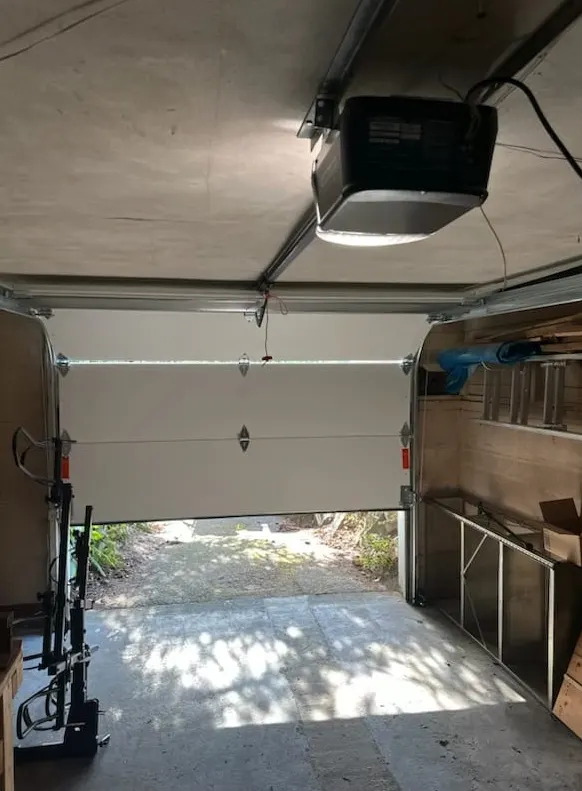
What a Tech Sees on This Call
The call usually sounds the same: the door goes down a foot, stops, and reverses back up. Sometimes it won't even attempt to close at all. The homeowner has already checked the remote batteries and tried the wall button a dozen times. When the tech walks into the garage, the first thing they do is kneel down and look at the two small sensor eyes mounted about six inches off the floor on either side of the track. More often than not, one of them is coated in a film of road grime, has a spider web strung across the lens, or is tilted a few degrees out of alignment because someone bumped a bike, a trash can, or a snow shovel into the bracket.
These photo eyes are part of the federally required safety system on every residential opener made since the late 1980s. They send an invisible infrared beam across the bottom of the opening. If something breaks that beam while the door is closing, the door reverses instead of continuing down. It is a good system. It is also a sensitive one, and it does not take much to confuse it.
Why They Trip So Often Around Here
A few things make this a frequent complaint in this region specifically:
- Humid summers fog the lenses. Condensation builds up on the sensor glass the same way it does on a bathroom mirror, especially on muggy mornings after a warm night. A foggy lens can't see a clean beam, so the opener assumes something is blocking it.
- Heavy rain and splashback carry grit onto the lenses. Garages near the street or with a sloped driveway take on spray from passing cars, especially during storms. That dried grime sits right on the glass.
- Icy winters mean more bumps. Salt-crusted boots, shovels, sleds, and extra gear moving through a tight garage increase the odds that a sensor bracket gets nudged out of true alignment.
- Older housing stock means older brackets. In homes with garages that have been retrofitted or repaired over the years, sensor brackets are sometimes mounted on wood trim that has warped or settled, slowly changing the alignment without anyone noticing.
- Direct sun can wash out a sensor. If a garage faces the right direction, low winter sun angling in can overpower the receiving eye for a few minutes a day, which is why some doors only misbehave at certain times.
How Bad It Gets
Most of the time this is just an annoyance: the door won't close, you try again, eventually it works. But there are two worse outcomes worth taking seriously.
First, a door that won't close reliably often gets left open. In icy weather that means a garage, and anything attached to it, loses its buffer against the cold. Pipes along a shared wall, a water heater, or stored paint and chemicals are all exposed to temperatures they weren't built for. An open garage is also an easy entry point, which matters more in older neighborhoods where garages open directly into the house.
Second, and more serious: when a sensor is unreliable, some homeowners or handymen disconnect it rather than fix it. That removes the one feature standing between a closing door and a car bumper, a pet, or a child darting through at the wrong moment. A garage door is one of the heaviest moving objects in most homes. The sensors exist because doors have closed on people and pets before the technology was required. Bypassing them trades a five-minute annoyance for a risk that isn't worth it under any circumstances.
Cleaning and Aligning Them the Right Way
- Power down first. Unplug the opener or shut off power at the breaker before handling anything near the sensors.
- Wipe each lens with a soft, dry microfiber cloth. Avoid household glass cleaner with ammonia, which can leave a residue. A dry or slightly damp cloth is enough for most dirt and condensation film.
- Clear debris around the brackets. Spider webs, dust, and leaves collect in the mounting hardware itself, not just on the lens.
- Check that both brackets sit at the same height and face each other squarely. Most openers have a small LED on each sensor. Steady light on both usually means good alignment; a flickering or dark light on one side means it needs adjustment.
- Loosen the wing nut or screw on the bracket, nudge the sensor slightly, and retighten. Small movements matter here. A quarter inch of tilt is often the difference between a solid beam and a tripped one.
- Test with the door fully functional, not with the safety reverse disabled. If it closes cleanly and stays down, the fix worked.
If the lights won't hold steady no matter how carefully you align them, the sensor itself, its wiring, or the opener's circuit board may be the real problem, not the dirt or the bracket.
When to Call Baltimore Garage Door
If you've cleaned and aligned the sensors and the door still won't close, or the LED indicators stay dark even with power confirmed, it's time to call. Baltimore Garage Door's opener service covers sensor wiring, bracket replacement, and circuit diagnostics, and a seasonal maintenance visit checks sensor alignment along with springs, rollers, and cables before winter weather makes small problems worse.
If your garage door is leaving you guessing every time it closes, call Baltimore Garage Door. We serve Baltimore, Towson, Dundalk, Catonsville, Parkville, Essex, Pikesville, and Rosedale, and we'll get your sensors reading clean and your door closing the way it's supposed to.